Buying on Palm Jumeirah and hearing a lot about owners association fees? You are not alone. OA fees can shape your monthly budget and your long-term costs, especially in a sea-facing community where maintenance needs are unique. In this guide, you will learn what OA fees usually cover, how they are set, why frond villas and tower apartments differ, and how to compare fees before you buy. Let’s dive in.
What OA fees cover on Palm Jumeirah
Included services and upkeep
OA fees fund the shared spaces and systems that keep your building or community running. On Palm Jumeirah, they typically include:
- Maintenance of communal areas like lobbies, corridors, and shared halls
- Building systems such as elevators, fire systems, pumps, and emergency equipment
- External building care where applicable, including façade cleaning and repairs
- Landscaping, promenades, parks, and planted areas
- Security and access control for communal areas, including gates and CCTV
- Street and internal road maintenance managed by the community
- Beach and seawall upkeep where these areas are communal
- Pools, gyms, and other shared amenities
- Cleaning and waste collection for common areas
- Utilities for shared spaces like corridor lighting and outdoor lighting
- OA management and administration costs
- Preventive maintenance contracts for key systems
- Insurance for common property assets
- Reserve or sinking fund contributions for future major repairs
What is usually not included
You still handle your own unit’s running costs. Common exclusions include:
- Your apartment or villa’s electricity and water
- Interior repairs and appliance replacements
- Private villa pool and garden upkeep unless your community states otherwise
- Personal services such as in-unit cleaning or optional valet programs
Who sets and oversees fees
RERA, under the Dubai Land Department, sets the rules for service charges, transparency, and dispute resolution. Developers typically manage communities at first. On Palm Jumeirah, Nakheel is the master developer, though management can be handed to an OA or a specialist management company once formation and handover thresholds are met.
As an owner, you should expect transparency. OA budgets are prepared annually and audited accounts must be available to owners. If you believe charges are inappropriate or obligations are not being met, you can use RERA’s established routes for complaints and dispute resolution.
Why villas and towers differ in fees
Scale and amenities
Towers share costs across many units, which can create economies of scale. At the same time, high-end amenities such as multiple pools, large concierge teams, and central chilled water systems can raise budgets. Frond villas have fewer owners sharing costs, along with more exterior surfaces and plot-level responsibilities, so per-unit expenses are commonly higher.
Marine environment and maintenance
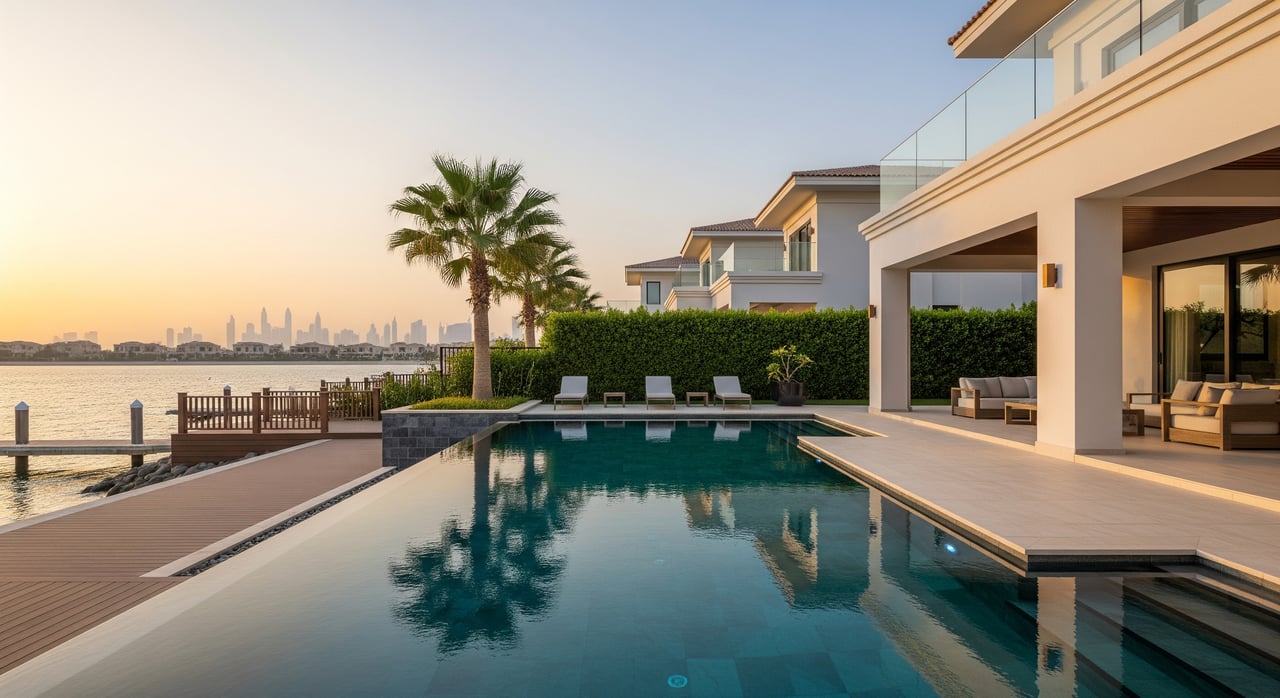
Palm Jumeirah’s coastal setting adds wear. Saline air increases corrosion on façades, metal fittings, seawalls, and pool equipment. This coastal exposure often drives higher maintenance intensity for frond villas and low-rise buildings near the shoreline.
Management model and collections
Whether a community is developer-managed or run by an OA with an appointed manager can influence cost structure and transparency. Collection rates matter too. If many owners fall into arrears, the OA may adjust fees or use special levies to cover shortfalls.
How fees are calculated and billed
Common calculation methods
Expect one of these approaches:
- Per square foot per year, often for apartments
- Fixed per unit per year, common in some villa communities
- Banding by unit size, such as by bedroom count, in certain towers
- Percentage share allocation defined by the community’s deed
Budget cycle and reserves
OAs prepare an annual budget covering operations and reserve fund contributions. Approved charges are invoiced monthly, quarterly, or annually. Reserve funds help pay for future major works like façade projects or plant replacement. If reserves are low, special levies can occur.
Special levies
Unexpected repairs or underfunded reserves may trigger one-off assessments. Always review recent history to understand how often special levies have occurred and why.
How to compare fees before you buy
Documents to request
Ask the seller or management for:
- Latest approved annual budget with a category breakdown
- Audited accounts for the last 2 to 3 years
- The unit’s service charge ledger or statement, including any arrears
- Minutes from recent OA or community meetings
- OA rules and the allocation schedule that explains how costs are shared
- The management contract and key service contracts
- Collection rate data and any active recovery efforts
- Plans for major works, special levies, or known deferred maintenance
Metrics to normalize
To make a like-for-like comparison:
- Convert to AED per square foot per year for apartments
- For villas, look at AED per unit per year and AED per square foot of built-up area
- Assess amenities per unit, such as pools per 100 units or gym size per resident
- Check reserve strength as a percentage of annual operating costs
- Review annual percentage changes in service charges for the past 2 to 3 years
- Note collection rates, as high arrears are a risk indicator
Smart questions to ask
- What exactly is included in the service charge for this unit?
- How are costs apportioned: by square footage, per unit, or by band?
- What is the current reserve balance and target level?
- Any special levies in the past 3 to 5 years or planned soon?
- What proportion of owners are in arrears?
- Who manages the community and are major contracts competitively tendered?
- How often are budgets reviewed and how are increases communicated?
Quick comparison checklist
- Get the budget and 2–3 years of audited accounts
- Request the last 12 months of invoices for the specific unit
- Confirm reserve fund levels and recent special levies
- Clarify inclusions and exclusions, especially utilities and private pool/garden care
- Review the management company and key vendor contracts
- Normalize to AED per square foot per year for apartments and AED per unit per year for villas
Red flags to watch for
- Large or frequent annual increases without clear justification
- Repeated special levies or one-off charges
- High arrears and low collection rates
- Missing or unclear audited accounts and meeting minutes
- Confusion over who is responsible during a handover period
- Visible deferred maintenance on shared elements, such as corrosion or worn landscaping
- Reserve funds that seem too low for the community’s age and condition
Budgeting tips for Palm buyers
- Expect variance by building and frond. Sea exposure and amenity levels can push costs higher.
- Include OA fees in your affordability planning. Treat them like a recurring housing cost alongside your mortgage.
- Keep a contingency. Even well-run OAs sometimes need special levies for major works.
- Think value, not just price. A slightly higher fee can be fair if amenities, condition, and reserves are strong.
Verify before you commit
Confirm details directly with official and community sources. RERA and the Dubai Land Department set the framework for owners associations and disclosures. Nakheel, as the master developer for Palm Jumeirah, can clarify master-community responsibilities on trunk, crescent, and frond assets. The building or community management company should provide current budgets, audited accounts, and invoicing practices. For benchmarking and deeper due diligence, independent property managers or surveyors can assess reserve adequacy and future capital needs.
Work with a trusted advisor
Buying on Palm Jumeirah is a significant lifestyle and financial decision. You deserve clear answers about OA fees, reserves, and long-term costs before you sign. If you want a second-home or investment perspective with practical, step-by-step due diligence, our team is here to help. Connect with Capdevila Realty for bilingual, high-touch guidance tailored to your goals.
FAQs
What are OA fees on Palm Jumeirah and what do they cover?
- OA fees fund the operation, security, cleaning, landscaping, maintenance, insurance, and long-term reserves for shared areas and systems in your building or community.
How are Palm Jumeirah service charges calculated for apartments vs villas?
- Apartments are often billed per square foot per year, while villas may be on a per-unit basis or also normalized by square footage depending on the community.
Why do frond villas often have higher per-unit costs than towers?
- Fewer owners share costs and villas have more exterior exposure and plot-level upkeep, while towers spread costs across many units but may fund extensive shared systems.
What is a reserve or sinking fund and why does it matter?
- It is money set aside for future major repairs like façade works or plant replacement; strong reserves reduce the risk of sudden special levies.
What documents should I request before buying on Palm Jumeirah?
- Ask for the latest budget, audited accounts, the unit’s invoice history, meeting minutes, allocation schedule, management contracts, and reserve and collection-rate details.
How can I spot red flags in OA fees and management?
- Look for frequent fee spikes, repeated special levies, high arrears, missing audited accounts, unclear responsibilities, visible deferred maintenance, and very low reserves.